
AI agents and business automation
Less routine work. More time for your business.
Checking orders, answering customer questions, keeping track of prices and stock, preparing reports — everyday tasks take a lot of time.
At dkwebstudio, we create AI agents and automations tailored to your workflows. Working within predefined rules, they check information, carry out authorised tasks and let you know where your decision is needed.
You set the rules and stay in control. The system takes on the routine work you have agreed to delegate.
From information to action
- Incoming information
- Processing
- Your decision
- Execution
What do we mean by an AI agent?
An AI agent is a software assistant with a specific task, limited access to the systems it needs and clear rules for taking action.
For example, an order-monitoring agent can periodically check for new orders, identify processing delays and send you a short report. A customer-support agent answers using approved information and passes complex cases to a member of your team.
From the outset, we define what the agent can do independently, when it must ask for your approval and when it must stop.
We develop AI assistants and automated workflows for recurring business tasks. For example: prepare answers to customer enquiries, monitor orders and flag exceptions, or compile recurring reports from agreed data sources.
What can we automate?
Customer supportAnswers to frequently asked questions based on your products, opening hours, delivery and service terms.Read moreShow less
We can set up:
- answers based on approved business information;
- sorting of incoming messages by topic and urgency;
- draft replies for a team member to approve;
- escalation of complaints, refund requests and unclear cases to a person.
We agree the scope of automated replies with you. The agent must not make a promise that the business has not authorised.
Order and delivery monitoringChecking order status and highlighting cases that need attention.Read moreShow less
The system can:
- identify new and unprocessed orders;
- check payment and processing statuses;
- track shipments using available carrier data;
- notify you of delays or problematic statuses;
- prepare a daily summary.
We keep statuses clearly distinct: for example, a parcel that has arrived at a post office will not be treated as delivered to the customer.
Products, prices and stockComparing catalogue data and identifying changes promptly.Read moreShow less
We can connect store and supplier data so that an agent can check:
- changes in purchase prices;
- stock availability;
- differences between the website, working file and supplier records;
- duplicate or incomplete data;
- margins that fall below a predefined threshold.
Detecting a change does not automatically mean publishing it. If you prefer, the agent first shows you the exact product, its current data and the proposed change.
Email and business correspondenceProcessing incoming email so that important issues do not go unnoticed.Read moreShow less
Automation can include:
- grouping emails by topic;
- identifying replies from suppliers and partners;
- translating emails and preparing brief summaries;
- drafting replies;
- keeping track of issues that have not received a response.
Sending an email is governed by a separate rule: only with your approval or within a strictly defined scenario agreed in advance.
Content and social mediaOrganising content preparation and publishing around your brand’s rules.Read moreShow less
We can set up the preparation of copy based on product data, a content calendar and publishing to agreed channels. The process can also include checks of prices, links and required fields.
Preparing the copy, obtaining your approval and publishing it are separate stages. The system follows the operating mode you choose.
Business reports and notificationsReceive a short report at agreed intervals covering the information you need to make decisions:Read moreShow less
- what has changed;
- what has been completed;
- where a problem was found;
- what could not be checked and why;
- what needs your approval.
Reports can be delivered through an agreed channel, such as email or Telegram. We check whether specific connections are possible before starting the project.
How does our approach work?
We study the process first
We establish how you do the work today, where you lose time and which stages would make practical sense to automate. We do not complicate a process simply to introduce AI.
Each agent has a specific responsibility
One agent might monitor prices, another might track orders and a third might prepare reports. Where needed, they work together within an agreed process, while each agent’s scope of action remains clear.
We work with your data
An agent’s answers and actions should be grounded in approved information: the product catalogue, service terms, order data and other agreed sources.
If data is missing or a source is unavailable, the system states this and flags the issue for review.
Important actions need approval
We can require your confirmation before a price is changed, an email is sent, a public post is published or an order is modified.
Payments, advertising spend and changes to access permissions will have their own separately agreed rules.
We verify the result
A task is not considered complete simply because it has started. Wherever technically possible, the system checks the saved change or resulting outcome again.
If an action could not be completed, the report shows the actual obstacle and the remaining step.
A work history is kept
We record completed actions, open issues and tasks awaiting approval. This makes it easier to continue the process and reduces the risk of repeating an action that has already been completed.
You choose the operating mode
You set the rules. You stay in control.
Monitoring: the agent only reads data and provides a report.
Preparation and approval: the agent prepares a reply or change, then waits for your approval before carrying it out.
Agreed automatic execution: the agent independently carries out only actions authorised in advance and records the result.
Different processes within the same business can use different operating modes.
How do we start working together?
- We discuss your daily work and choose the first process.
- We check the feasibility of connecting to the required systems and the necessary access permissions.
- We agree the scope, timeline, price and any additional service costs that may be required.
- We build and test the automation in a restricted environment or on an agreed small scale.
- Following your acceptance, we put it into operation.
Features and integrations are defined for each project. If a platform does not provide the necessary access, we discuss this before implementation.
Let’s start with one process
You do not need to automate your whole business at once. We can start with a task you repeat every day and whose result is easy to check.
Tell us which work takes up most of your time. Together, we will identify what can be automated and where a person should make the decision.
TRENDYSTORE / 07
How Trendystore automates its store
One store, seven distinct responsibilities. One agent replies to customers; others check orders, prices, shipments and other store operations.
Customer replies
- What happens
- A customer messages on Instagram or Facebook.
- What the agent does
- The agent checks the catalog and replies there. It hands complex cases to a person.
On November 8, an available alternative was offered on Instagram.
A shopper asks for a light moisturizer. The assistant checks the catalog, price and stock before replying in the same thread.
Reply and product card
Complaints and requests for a human go to the team.
Orders & payments
- What happens
- A scheduled review starts.
- What the agent does
- It matches order totals with successful Shopify transactions.
This verifies Shopify transactions, not bank settlement.
At 20:00 the agent matches order totals with successful transactions and separates test orders.
Reconciliation report
| Order | Order total | Successful payment | Result |
|---|---|---|---|
| DEMO-104 | €29.90 | €29.90 | Matched |
| DEMO-105 | €22.00 | — | Review |
| TEST-01 | €1.00 | €1.00 | Test only |
A Shopify match does not prove bank settlement. The agent does not touch payments.
Prices & stock
- What happens
- The agent checks prices and stock for more than 500 products every day.
- What the agent does
- In the euro example, the agent converts the supplier’s USD cost to EUR and compares it with the Shopify selling price and the approved Excel price.
If the selling price does not cover the purchase cost, the agent alerts the owner. It raises the price only after the owner approves, using the owner’s pricing rule.
Every day at 21:00, the agent checks supplier prices and stock for more than 500 products and compares the data with Excel and Shopify. Illustrative exchange rate: 1 USD = 0.90 EUR.
Purchase cost vs. selling price
- ExcelOwner-approved retail price
- Supplier APIWholesale cost in USD and stock
- ShopifyAdmin and storefront prices checked separately
| SKU | Excel · approved | Supplier · Purchase cost | Shopify · Selling price | Result |
|---|---|---|---|---|
| DEMO-01 | €22.00 | Before: €7.02 Now: €24.30 (27.00 USD) In stock | €22.00 | Loss warning: −€2.30 per item |
| DEMO-02 | €18.00 | €4.95 (5.50 USD) Sold out | €18.00 | Out of stock |
| DEMO-03 | €32.00 | €9.90 (11.00 USD) In stock | €35.00 | €3.00 above Excel price |
The €22.00 selling price for DEMO-01 made sense at the previous purchase cost of €7.02. Then the supplier raises the cost to €24.30. The store price stays the same for now. The agent warns that each sale now loses €2.30 before other costs. It only changes the store price after approval.
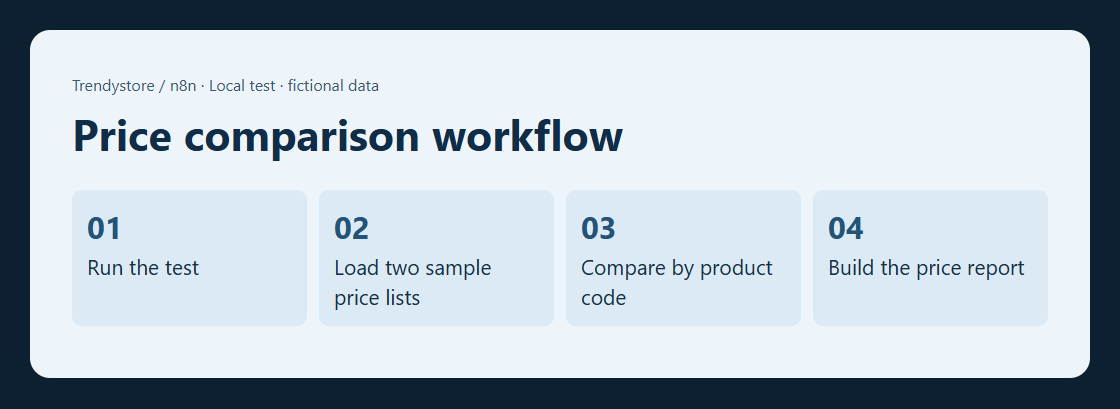
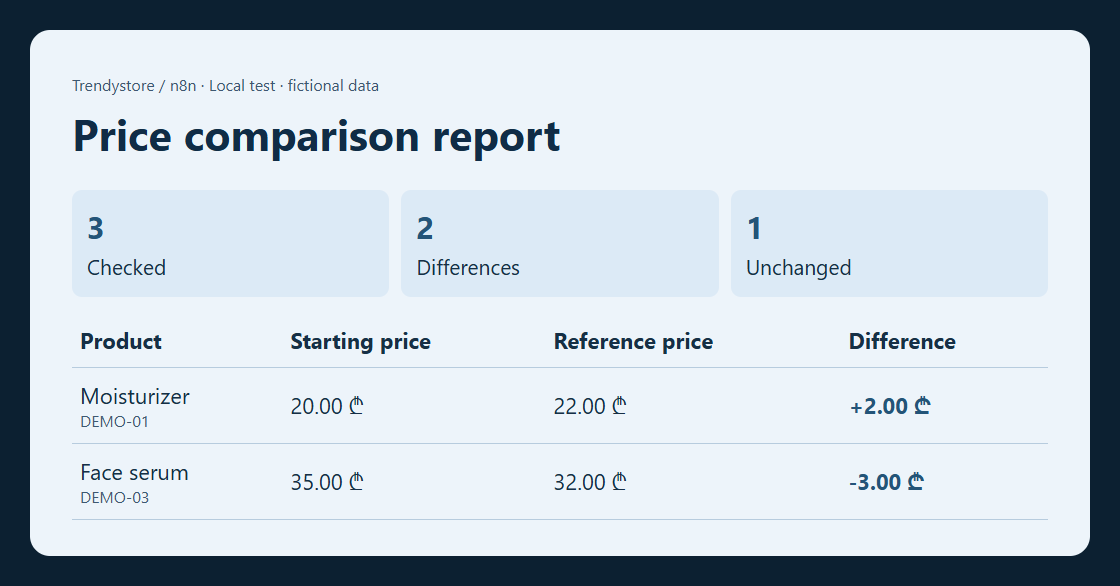
n8n canvas and sample report
Separate local n8n test with fictional data. The original test used GEL, not euros.
Shipment tracking
- What happens
- Postal tracking shows a new event.
- What the agent does
- It checks Korea Post and Georgian Post by tracking number and shows where the parcel is.
In this example, the parcel was sent from Korea on November 15. On November 17, Georgian Post confirmed it was in the customs zone.
At 22:00, the agent checks both postal services using the tracking number on the Shopify order.
Parcel route from Korea to Georgia
- November 15 · Parcel dispatched from KoreaKorea Post
- November 17 · Confirmed the parcel is in the customs zoneGeorgian Post
- The parcel is in the customs zone in Georgia. It is still in transit and has not been delivered.Agent
The owner sees the parcel’s route and last confirmed status in one place. The agent does not change the Shopify status or message the recipient.
Site & cart
- What happens
- A scheduled site check starts.
- What the agent does
- It checks pages and cart data in Georgian, English and Russian (KA, EN and RU). It does not make a payment.
On November 16, the checks covered homepages, carts and one bundle page.
On Mondays at 12:00 the agent checks homepage and cart data in three languages, plus a bundle page.
Health check
| Surface | Coverage | Result |
|---|---|---|
| Homepage | KA / EN / RU | 3/3 opened |
| Cart data | KA / EN / RU | 3/3 opened |
| Bundle | 1 page | Correct product |
The report flags anything that needs attention. No actual payment or repair is performed.
Ads & analytics
- What happens
- Daily data is ready to compare.
- What the agent does
- It reconciles Meta, GA4 and Shopify data. It does not change budgets.
On November 17, sales could not be reliably attributed to a particular ad.
At 23:00 the agent reviews ad spend, analytics events and paid orders for the same reporting window.
Campaign readout
| Source | What it shows | Interpretation |
|---|---|---|
| Meta Ads | €0.00 · 0 impressions | Schedule ended |
| GA4 | 2 purchase events | Attribution unconfirmed |
| Shopify | 2 paid orders | Sales exist |
The owner sees why the sales were not assigned to an ad. Budget or campaign changes require separate approval.
Organic posts
- What happens
- An approved publishing slot arrives.
- What the agent does
- It checks the product, prepares slides and verifies publication by channel.
On November 18, a post was verified on Facebook, Instagram and TikTok.
At 19:30 the agent picks an unpublished product, checks price, stock and details, and prepares four slides.
Four slides for one post
- Facebook ✓
- Instagram ✓
- TikTok ✓
It verifies scheduled publishing on Facebook, Instagram and TikTok separately. This is organic content, not paid advertising.
Let’s start with your idea
Your next
step —
starts here.
Web development, AI automation or SEO: tell us what you want to build or improve. Together we will define the right next steps.
info@dkwebsitestudio.comYou can also email us directly.